Technology · Technology
660 nm and 850 nm explained: choosing wavelengths, dose and device
Wavelength decides where the light goes. Irradiance and time decide whether enough of it arrives.
14 July 2026 · 12 min read
Key takeaways
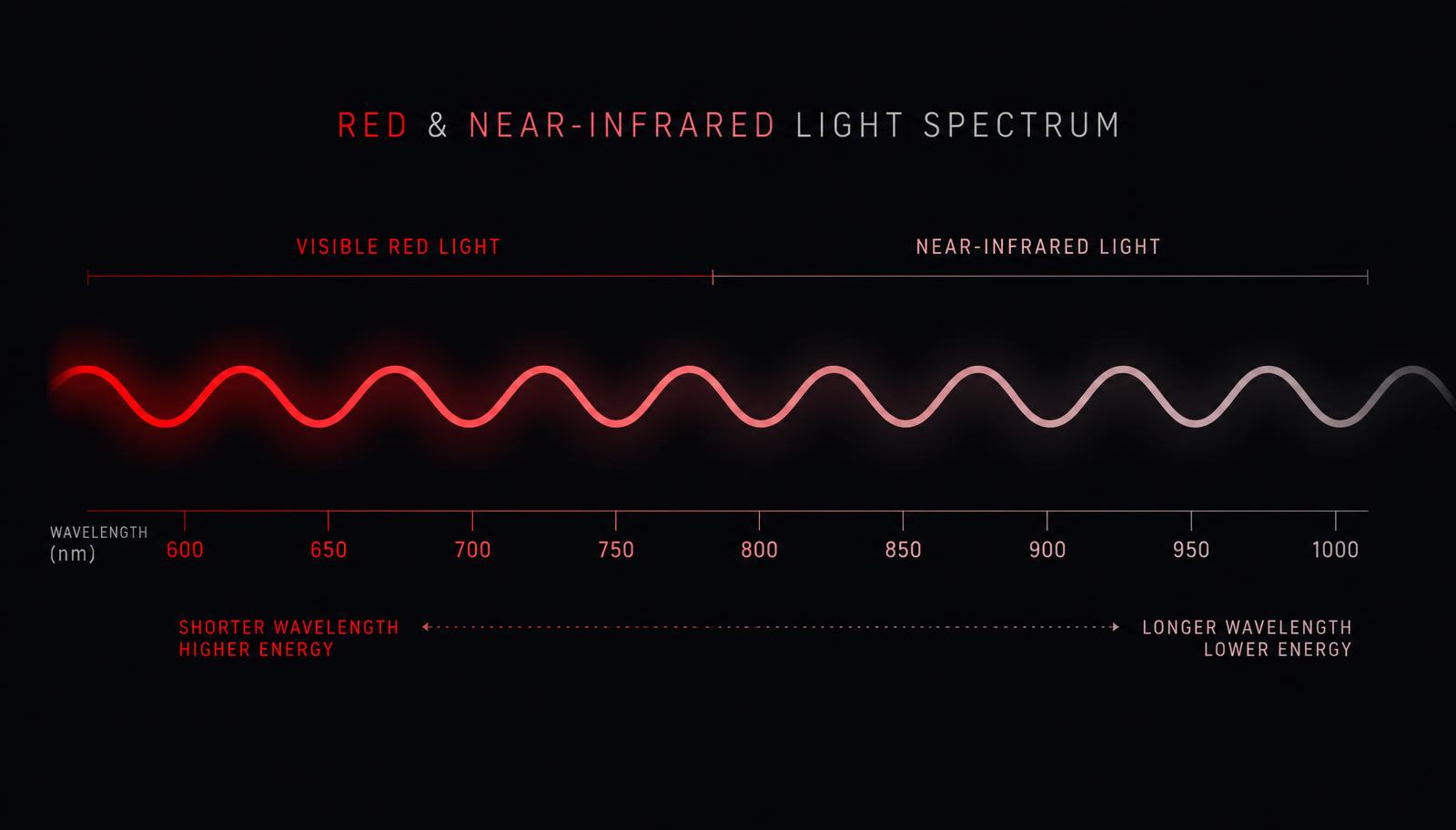
- The therapeutic optical window sits roughly between 600 and 1100 nm.
- 660 nm targets skin and capillaries; 850 nm reaches muscle, joints and deeper tissue.
- Dose (J/cm²) = irradiance (mW/cm²) × time (s) ÷ 1000.
- Irradiance quoted at 0 cm is marketing; irradiance at 15–30 cm is information.
- Flicker, beam angle, LED binning and thermal design matter more than raw wattage.
The optical window
Human tissue contains three chromophores that dominate light absorption: melanin, haemoglobin and water. Melanin and haemoglobin absorb strongly below 600 nm; water absorbs strongly above about 1100 nm. Between those two walls lies a corridor where photons scatter but are not immediately absorbed, and can therefore travel into tissue.
That corridor is the therapeutic window. Everything credible in photobiomodulation happens inside it, and the two most studied points within it are 660 nm and 850 nm — chosen because they sit close to the absorption peaks of cytochrome c oxidase while remaining in low-absorption territory for the surrounding tissue.
660 nm versus 850 nm, honestly
| 660 nm (red) | 850 nm (near-infrared) | |
|---|---|---|
| Visible | Yes, deep red | No, invisible |
| Depth | 1–5 mm | 20–40 mm |
| Main targets | Epidermis, dermis, capillaries | Muscle, joints, deep connective tissue |
| Typical uses | Skin tone, texture, collagen, wounds | Recovery, joints, systemic sessions |
| Feels | Slight warmth, bright | Warmer, no visible light |
Neither is superior. They address different depths, and the sensible answer for a general-purpose device is both, delivered simultaneously rather than in separate modes — because most real targets span more than one tissue layer.
What about 630, 810 and 830 nm?
All are well supported by research. 630 nm behaves like 660 with slightly less depth; 810 and 830 nm are the most studied bands for neural applications. Small differences within a band matter far less than dose and consistency.
The only formula you need
Dose, expressed as energy density in joules per square centimetre, is what determines the biological effect. The arithmetic is trivial:
Dose formula
J/cm² = irradiance (mW/cm²) × time (seconds) ÷ 1000. A 100 mW/cm² device for 10 minutes delivers 60 J/cm² at the surface.
Because the response is biphasic, the target is a range rather than a maximum. Superficial skin goals are typically met between 3 and 10 J/cm². Deeper musculoskeletal targets need more at the surface — commonly 20 to 60 J/cm² — because scattering and absorption cut what arrives at depth by an order of magnitude or more.
| Irradiance at distance | For 6 J/cm² | For 30 J/cm² |
|---|---|---|
| 30 mW/cm² | 3 min 20 s | 16 min 40 s |
| 60 mW/cm² | 1 min 40 s | 8 min 20 s |
| 100 mW/cm² | 1 min | 5 min |
How to judge a device without a spectrometer
- Irradiance with distance stated. A number without a distance is meaningless; ask for the value at 15 cm and 30 cm.
- Flicker. Cheap drivers pulse at mains frequency. Point a phone camera at the panel: visible banding means a poor driver.
- Beam angle. 60° spreads light and drops irradiance fast; 30° concentrates it but narrows coverage.
- Wavelength accuracy and binning. Reputable manufacturers state a tolerance, typically ±10 nm.
- Thermal management. LEDs lose output as they heat. Passive heatsinks or quiet fans preserve irradiance over a session.
- EMF and safety certification. Look for the relevant electrical certification and a stated photobiological safety group.
- Coverage area. Total power tells you nothing if it is concentrated in a spot the size of a coaster.
The specification that matters is the one measured at the distance you will actually use.
Five common mistakes
- Sitting too close, assuming more intensity is more benefit. It usually just overshoots the optimum.
- Treating through clothing. Fabric absorbs and scatters a large fraction of the light.
- Switching devices, distances and durations every week, then concluding nothing works.
- Ignoring near-infrared because it is invisible and therefore feels like nothing is happening.
- Judging results at three weeks when the tissue you are targeting remodels over three months.
Fix those five and you will extract more from a modest panel than most people extract from an expensive one.
Frequently asked questions
What is the difference between 660nm and 850nm red light?
660 nm is visible red light that penetrates one to five millimetres and mainly targets skin, capillaries and dermal fibroblasts. 850 nm is invisible near-infrared that reaches two to four centimetres, making it appropriate for muscle, joints and deeper connective tissue. Most quality devices emit both simultaneously.
How many joules do I need per session?
Skin goals are usually met between 3 and 10 J/cm² at the surface. Deeper musculoskeletal targets commonly use 20 to 60 J/cm² at the surface because scattering greatly reduces what reaches depth. Calculate with irradiance in mW/cm² multiplied by seconds, divided by 1000.
How far should I sit from a red light panel?
For most panels, 15 to 20 cm suits deeper targets and 25 to 40 cm suits skin and whole-body sessions. The right distance depends on the panel's irradiance curve, which is why manufacturers should publish measurements at multiple distances.
Does a higher wattage device work better?
Not necessarily. Total wattage says nothing about irradiance at your treatment distance, beam angle, wavelength accuracy or flicker. A well-engineered 200 W panel can deliver a better dose than a poorly designed 400 W one.