
Technology
Why red light therapy works
No wellness folklore. Just photobiomodulation: specific wavelengths of light, absorbed by specific molecules, producing measurable effects in your cells.
Cellular energy
Light your mitochondria can actually use
Inside every cell, mitochondria convert oxygen into ATP — the energy currency your body spends on repair. An enzyme called cytochrome c oxidase absorbs red and near-infrared photons at very specific wavelengths.
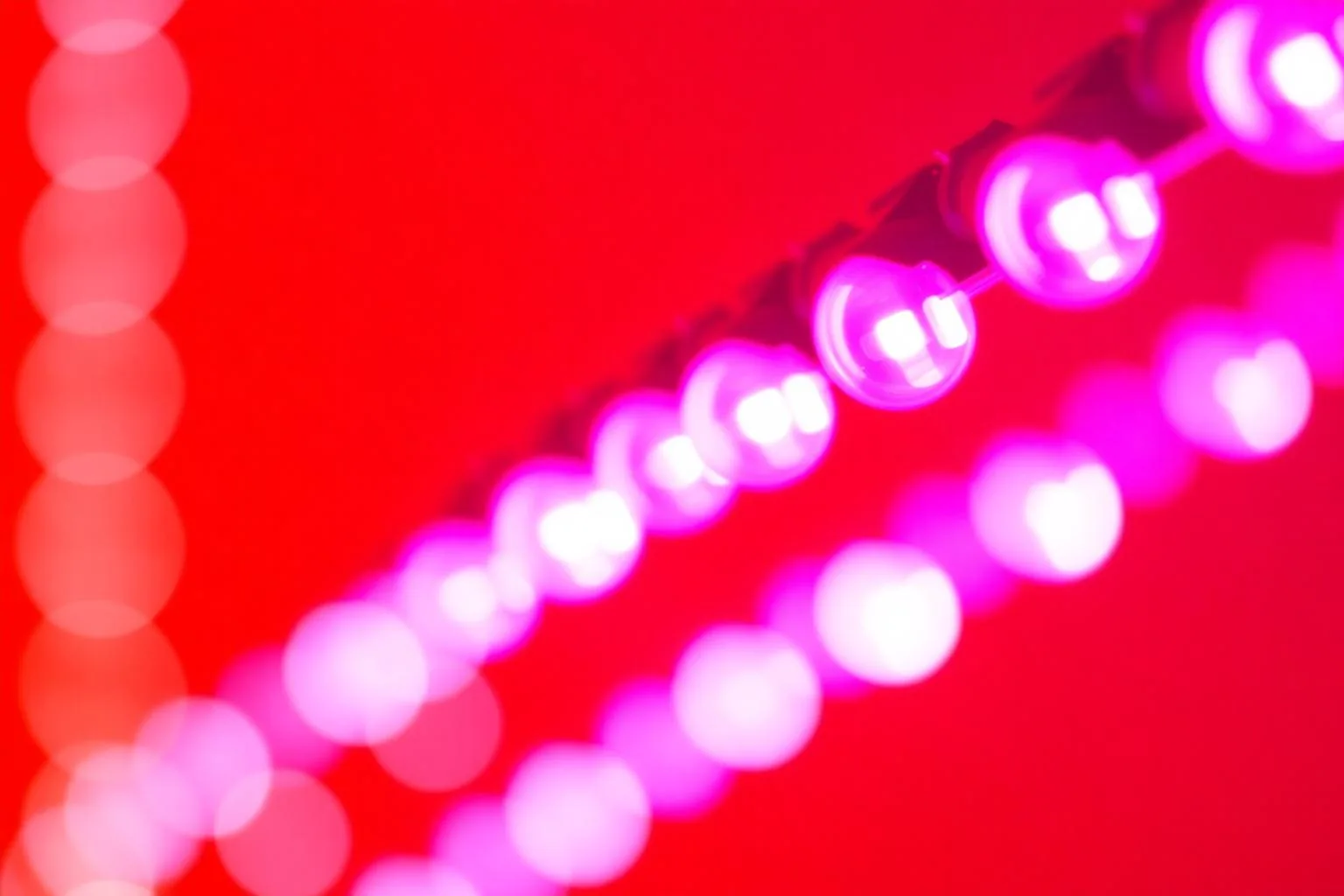
HALO emits 660nm red and 850nm near-infrared light, the two peaks where that absorption is strongest. More available energy means faster repair, better circulation and a measurable drop in oxidative stress.
Depth of penetration
Two wavelengths, two different depths
Red light at 660nm is absorbed within the first millimetres of tissue, where it supports collagen synthesis, tone and skin barrier quality.
Near-infrared at 850nm is invisible and travels several centimetres deeper, reaching muscle, joints and nervous tissue. Combining both in one session covers surface and depth at the same time.

Dose, not intensity
Irradiance and time are the real prescription
Red light therapy follows a biphasic dose response: too little does nothing, too much stops helping. What matters is joules delivered — irradiance multiplied by session time.
Every HALO device is calibrated so a 10 to 15 minute session at the recommended distance lands inside the effective window, session after session, without guesswork.

Engineering
Clean light, medical-grade components
Flicker-free drivers, low EMF, no UV and no filler wavelengths. Only the light your cells respond to, produced by binned LEDs that hold their output over thousands of hours.
Thermal management keeps the panel surface comfortable so you can stay in the beam long enough for the dose to count.

We believe in meaningful conversations. To help you out, we provide a free 20-minute call to answer your questions.
Book a free callRed light (around 630–660nm) is absorbed close to the surface and mainly supports skin, tone and collagen. Near-infrared light (810–850nm) is invisible and travels deeper, reaching muscles, joints and nervous tissue.
No. Sunlight delivers a full spectrum including UV, which triggers vitamin D synthesis. Red light therapy delivers only specific therapeutic wavelengths, without UV — it complements daylight rather than replacing it.
Most people notice better sleep and recovery within 2–3 weeks of consistent daily sessions. Skin and collagen changes typically become measurable after 8–12 weeks.
Near-infrared light sits outside the visible spectrum, so the panel appears mostly dark with a faint glow. The LEDs are working at full power — your eyes simply cannot see those wavelengths.